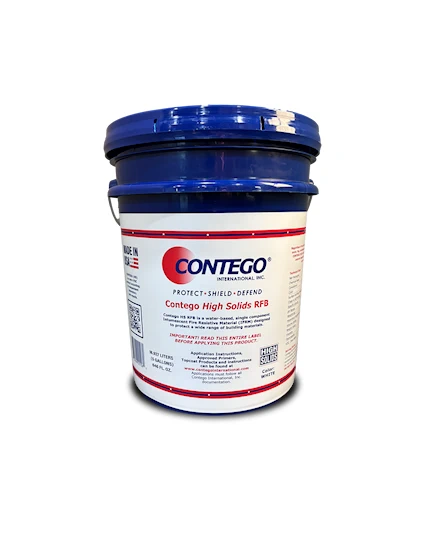
Description
Contego High Solids Intumescent Paint for Steel
When it comes to passive fire protection, structural steel has a critical vulnerability: extreme heat. During a cellulosic or hydrocarbon fire, unprotected steel can reach critical failure temperatures between 930°F and 1150°F, causing it to rapidly lose its yield strength and structural load-bearing capacity. Intumescent paint for steel is a highly advanced, reactive coating designed to prevent this catastrophic buckling. Here at National Fireproofing Supply, we offer industry-leading coatings that apply as easily as regular architectural paint but act as a lifesaving thermal blanket during an emergency.
How Intumescent Paint Protects Structural Steel
Unlike standard coatings, intumescent paints are engineered for dynamic reactivity. When ambient temperatures hit critical ignition thresholds—typically between 250°F and 570°F—the paint’s unique chemical trinity activates. This formulation usually includes an acid source (such as Ammonium Polyphosphate), a carbon source (like Pentaerythritol), and a blowing agent (such as Melamine. Under extreme heat, this mixture breaks down and releases non-flammable gases, causing the thin film to swell up to 50 to 100 times its original thickness. This reaction forms a dense, microporous carbonaceous foam known as “char”. This incredibly thick char layer features exceptionally low thermal conductivity, insulating the steel, slowing down heat transfer, and giving occupants vital time to safely evacuate before structural collapse occurs.
Meeting Building Codes with Precision Fire Ratings
Whether your commercial project demands a 30, 60, 90, or 120-minute fire resistance rating, our products are rigorously tested to meet strict third-party compliance standards, including ASTM E119 and UL 263. Determining the exact volume of paint needed to meet these codes is a precise science based on the steel’s Section Factor (Hp/A).
The Section Factor calculates the ratio of the steel section’s exposed heated perimeter to its cross-sectional area; slender beams heat up significantly faster and thus require a higher Dry Film Thickness (DFT) to maintain their structural elasticity. We encourage contractors to utilize the comprehensive steel coverage calculators available through National Fireproofing Supply to guarantee exact material requirements and code compliance
Flawless Application for Maximum Life Safety
A fireproofing system is only as reliable as its application. Inadequate surface preparation is the leading cause of intumescent coating failure. To guarantee proper adhesion and prevent delamination, steel surfaces must be meticulously cleaned of rust, oil, and mill scale, and prepped with a compatible anti-corrosive primer.
For a smooth finish and efficient coverage, application with a commercial-grade airless paint sprayer is highly recommended. Applicators must carefully measure Wet Film Thickness (WFT) using a gauge to ensure the final DFT accurately matches loading tables. Never dilute the product with water, as this alters the delicate fire-retardant chemistry and voids its efficacy. Following application, allow at least 24 to 72 hours of curing time. If the steel is located in a semi-exposed or high-humidity environment, finishing with an approved topcoat is essential to prevent environmental degradation
Secure Your Project with National Fireproofing Supply
Building safety cannot be compromised. Our passive fire protection selection includes versatile water-based coatings for eco-friendly indoor use. Equip your project with the high-performance protection it deserves. Browse our full catalog at National Fireproofing Supply to ensure your structural steel is fully protected against the unthinkable.
Reviews
There are no reviews yet.